You’re about to see how Italy’s Tax Incentive Created New Boutique Hotels is not just a policy story. It is a real shift in how people think about property, profit, and opportunity.
What looked like a generous tax break ended up reshaping entire neighbourhoods and quietly creating thousands of boutique hotels.
Meaning of How Italy’s Tax Incentive Created New Boutique Hotels
When we talk about “How Italy’s Tax Incentive Created New Boutique Hotels”, we’re referring to what happened after Italy introduced the Superbonus 110% scheme. The government allowed property owners to renovate buildings and recover more than the full cost through tax credits.
Yes, more than 100%.
What this really means is simple. You could upgrade a property, improve energy efficiency, restore old structures, and the government would cover the cost through future tax deductions or transferable credits.
Now imagine you own an old apartment in Rome or a forgotten building in Sicily. Suddenly, renovation is not an expense. It became an opportunity, and people took it.
Related Post: Hidden Costs of International Hotel Stays
Types of Boutique Hotels Created Through How Italy’s Tax Incentive Created New Boutique Hotels
The interesting part of How Italy’s Tax Incentive Created New Boutique Hotels is the variety. This was not just about luxury resorts. It touched different segments.
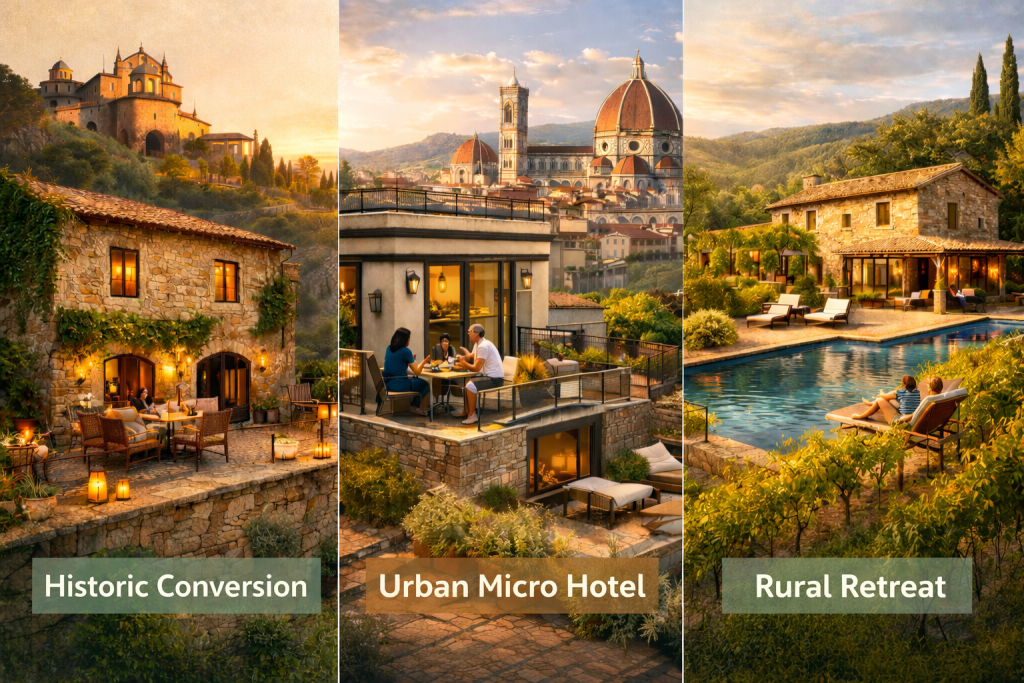
Historic Conversions
Old villas, centuries-old townhouses, and even abandoned monasteries were transformed into boutique hotels. These places already had character. The tax incentive simply made restoration financially possible.
Urban Micro Hotels
In cities like Milan and Florence, small apartment buildings were converted into stylish micro hotels. Think about fewer rooms, more design, and a strong focus on experience.
Rural Retreats
Countryside properties became wellness stays, vineyard lodges, and eco-friendly retreats. These are the places travellers now chase for quiet escapes.
Each type shows how flexible the incentive was. It did not force one model. It opened the door and let creativity do the rest.
Characteristics of How Italy’s Tax Incentive Created New Boutique Hotels
You can spot properties shaped by How Italy’s Tax Incentive Created New Boutique Hotels almost instantly if you know what to look for.
Firstly, there is a strong focus on sustainability. Energy-efficient systems, insulation upgrades, and solar panels became standard because they qualified for the bonus.
Secondly, design matters. These are not generic hotels. Owners invested in aesthetics because the renovation cost was covered.
Thirdly, smaller scale. Most of these hotels are intimate, with just about 10 to 30 rooms. They create a personal feel that large chains struggle to match.
Fourth is the location variety. You will find them in hidden villages, city centres, and coastal towns. The incentive did not limit geography.
So if you have ever stayed in a charming Italian boutique hotel and thought, ” This feels intentional”, there is a good chance the Superbonus played a role.
Aims and Objectives Behind How Italy’s Tax Incentive Created New Boutique Hotels
The government did not set out to create boutique hotels specifically. That is what makes How Italy’s Tax Incentive Created New Boutique Hotels so interesting. The main goals were clear.
To improve energy efficiency across buildings, reduce carbon emissions, stimulate the construction sector, and revive ageing infrastructure.
But here is the twist. When you give people financial freedom to renovate, they start thinking bigger.
Instead of fixing a house, they turn it into a business. Instead of repainting walls, they redesign the entire space.
So while the official aim was environmental and economic recovery, the real outcome included a tourism boom driven by unique accommodations.
Advantages of How Italy’s Tax Incentive Created New Boutique Hotels
There is a reason this policy gained so much attention, and a few of which include:
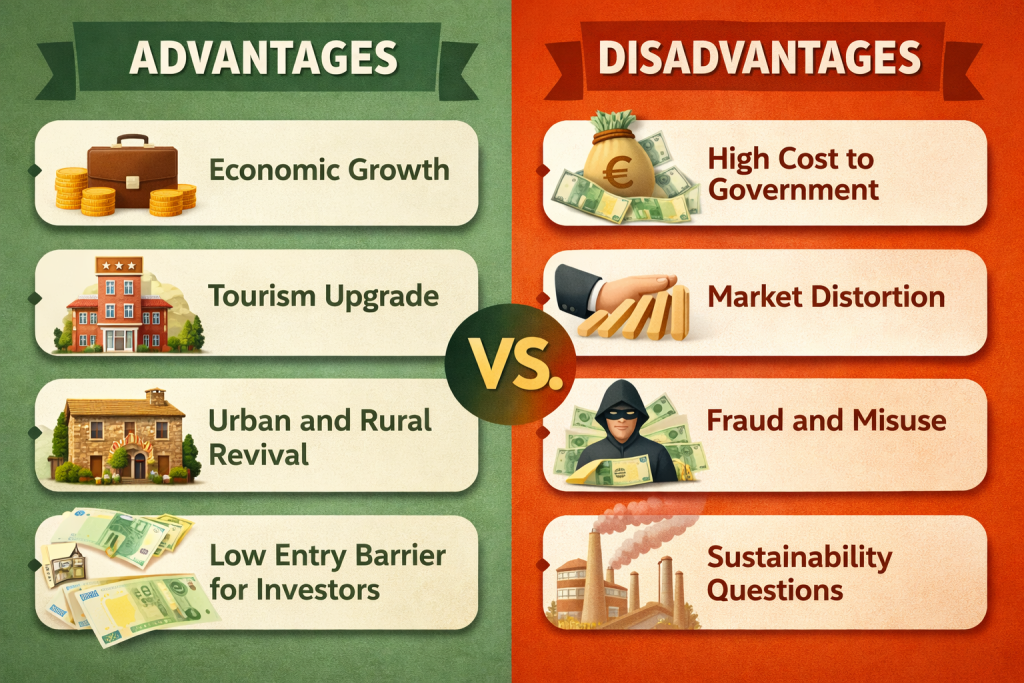
Economic Growth
Construction companies got busy, designers got occupied with work, and even property values increased. Tourism gained fresh inventory, and everyone along the chain benefited.
Tourism Upgrade
Travellers now have more unique places to stay. Instead of standard hotels, you get personalised experiences that get you comfortable.
Urban and Rural Revival
Abandoned buildings came back to life. Small towns that were fading suddenly had new energy, and then visitors followed.
Low Entry Barrier for Investors
Here is the part that catches your attention. You did not need massive capital. The tax credit reduced financial risk significantly.
This is where How Italy’s Tax Incentive Created New Boutique Hotels becomes more than a case study; it’s a model that can be followed.
Disadvantages of How Italy’s Tax Incentive Created New Boutique Hotels
Let’s not pretend it was perfect; it also had its downside, which includes:
High Cost to Government
Covering more than 100% of renovation costs is expensive. Critics argue that it placed a heavy burden on public finances.
Market Distortion
When incentives are this strong, they can push people into projects they would not normally pursue. That can lead to oversupply in some areas.
Fraud and Misuse
Where money flows easily, misuse follows. Some projects had inflated costs or did not meet proper standards.
Sustainability Questions
Ironically, some argue the environmental benefits were offset by the scale of construction activity itself.
So yes, How Italy’s Tax Incentive Created New Boutique Hotels has both wins and warnings.
Real Life Insight Into How Italy’s Tax Incentive Created New Boutique Hotels
Picture this in your mind. You inherit an old family property in a small Italian town. It needs serious work. Normally, you might sell it or leave it untouched. Then the Superbonus appears.
Suddenly, renovation becomes almost free. You think, why not turn this into a boutique stay? A few rooms, good design, maybe a small garden.
Fast forward a year. You are hosting guests from across the world. That’s not just an idea, it actually happened thousands of times.
So this tax incentive didn’t just change rules, it started a chain reaction.
Read Also: How to book the cheapest international flights in 2026
Conclusion
At the end of it all, How Italy’s Tax Incentive Created New Boutique Hotels shows what happens when policy meets human creativity. Give people the right incentive, and they do more than follow instructions.
They build something meaningful. The gamble worked in many ways, but it also raised serious questions about cost, control, and long-term impact. If you are paying attention, there is a lesson here for investors, governments, and even you.
Frequently Asked Questions
What is the Superbonus 110% scheme?
It is a government incentive in Italy that allows property owners to recover more than the full cost of certain renovations through tax credits.
Why did it lead to more boutique hotels?
Because renovation became financially attractive, many property owners chose to convert buildings into income-generating accommodations.
Is the policy still active?
It has been modified over time with reduced benefits and stricter conditions, but its impact is already visible.
Can other countries replicate this model?
Yes, but it requires careful planning. The financial cost and risk of misuse need strong control systems.
Is investing in boutique hotels still profitable in Italy?
It depends on location, demand, and management. The initial boom created opportunity, but long-term success depends on execution.
If you were given the chance to renovate a property with almost no cost, what would you build? That question is exactly what drove this transformation.